
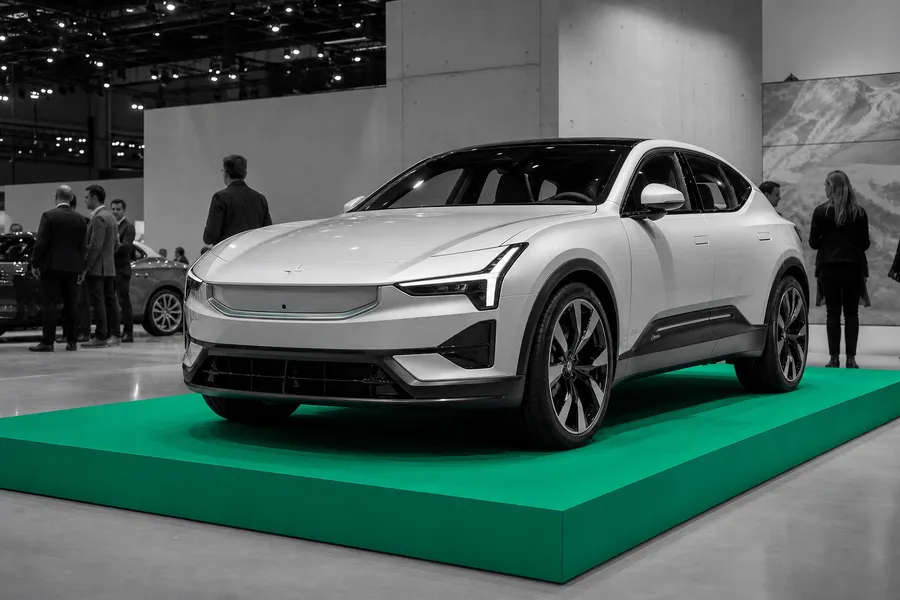
The U.S. Commerce Department has banned Polestar (PSNY) from selling new electric vehicles in the United States, forcing the majority Chinese-owned brand to exit a market where domestic EV rivals including Tesla have faced little equivalent regulatory headwind.
The move signals that Washington is prepared to use commerce-law tools beyond tariffs to restrict Chinese-linked auto brands, raising compliance risk for any EV maker with significant Chinese ownership seeking U.S. distribution.
Key Takeaways
- Commerce Department bans Polestar from selling new cars in the U.S.
- Polestar is majority-owned by Chinese interests via Geely Group.
- Broader Chinese EV brands already operate just miles from the U.S. border.
Market Reaction & Context
Polestar, which spun out of Volvo and is majority-owned by China’s Geely Group, now joins a lengthening list of Chinese-linked technology and industrial companies frozen out of the American market on national-security or trade grounds. 1 The ban is more sweeping than the existing 100%-plus tariff regime that already priced most Chinese-manufactured EVs out of U.S. dealerships, because it constitutes an outright sales prohibition rather than a price barrier.
The U.S. auto industry contributes an estimated $1.3 trillion to the economy annually, according to industry data cited by executives in recent interviews, making the sector a persistent flashpoint in the broader U.S.-China trade confrontation. 2 Polestar’s U.S. volumes were modest relative to Tesla or the Detroit Three, but the brand’s positioning as a premium, software-forward EV gave it outsized visibility among early adopters.
Detailed Analysis
The Commerce action underscores how Washington is broadening the toolkit used against Chinese-linked automotive players beyond tariffs alone. Rival Chinese brands-BYD, Geely’s own EX2 line, and Great Wall Motor-are already available at dealerships in Ciudad Juárez, Mexico, just five miles from the El Paso border crossing, where they are attracting American consumers who cross to compare prices. 2
Geely salesman Luis Hernandez said he has converted longtime Ford and Chevrolet owners with prices that undercut U.S.-market equivalents significantly. “If they were allowed to be sold in the United States,” Hernandez said of the Chinese models, “they would destroy the American car market.” 2
U.S. automotive executives, speaking in separate interviews, did not entirely dismiss that scenario. Without a coherent strategy to address Chinese competition, they said, affordable high-technology Chinese vehicles could disrupt an industry central to American manufacturing employment. 2
Regulatory Outlook
The Polestar ban arrives as Washington tightens restrictions across multiple technology vectors with Chinese ownership links, from semiconductors to software platforms. Investors holding shares in other EV or clean-energy companies with partial Chinese ownership or Chinese-domiciled supply chains should assess whether the Commerce Department’s legal rationale-details of which were not fully disclosed in initial reports-could be applied more broadly.
Polestar’s exit also removes a competitive data point that analysts used to benchmark premium EV pricing against Tesla, potentially narrowing the peer-comparison set available to equity researchers tracking the sector. The company has not indicated whether it will challenge the ban through administrative or judicial channels.
Conclusion
The Commerce Department’s ban on Polestar is the clearest demonstration yet that the U.S. is willing to move beyond tariffs to exclude Chinese-linked EV brands entirely, a regulatory escalation that sets a precedent with implications for any foreign automaker whose ownership structure draws Chinese-government-adjacent capital. Macro and sector investors should monitor whether similar actions target other hybrid-ownership EV or technology companies in the months ahead.
Not investment advice. For informational purposes only.
References
1(Jan 14, 2025). “US Finalizes Rule to Effectively Ban Chinese…”. Reddit/r/Polestar. Retrieved June 25, 2026.
2Ryan Felton (Apr 28, 2026). “The U.S. Wants to Ban China’s High-Tech Cars, but They’re Already Here in El Paso”. The Wall Street Journal. Retrieved June 25, 2026.