
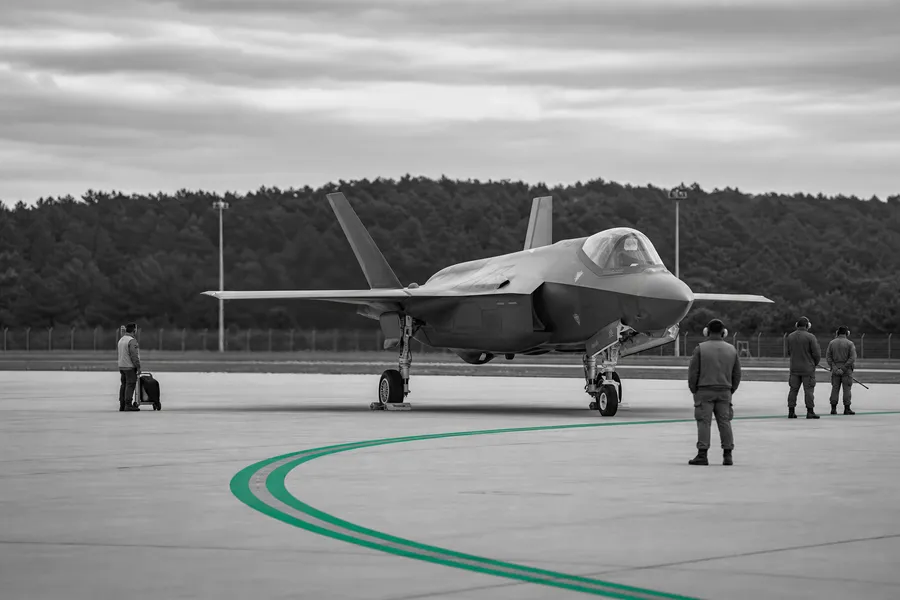
President Donald Trump said Tuesday he would lift sanctions on Turkey and weigh restoring Ankara’s access to the F-35 programme, a policy shift that could reshape Lockheed Martin’s (LMT) export pipeline and rattle allied defence procurement markets.
A confirmed sale would unblock a deal that has been frozen since 2019, potentially worth billions of dollars to Lockheed’s aeronautics segment, while simultaneously forcing NATO partners to reassess interoperability risks tied to Turkey’s existing Russian S-400 air-defence system.
Key Takeaways
- Trump pledges to lift CAATSA sanctions imposed over Turkey’s S-400 purchase.
- F-35 sale faces a congressional ban that the White House has not yet addressed.
- Lockheed Martin’s aeronautics backlog could gain a multi-billion-dollar lift.
Market Reaction & Context
Lockheed Martin (LMT) shares were in focus Tuesday as defence investors parsed the implications of a potential reinstatement of Turkey into the F-35 Joint Strike Fighter programme. Turkey had originally been a programme partner before its removal in 2019 following the S-400 purchase, a decision that cost Ankara an estimated $12 billion in planned procurement and removed Turkish manufacturers from the supply chain.1
Broader U.S. defence names, including Raytheon Technologies (RTX) and Northrop Grumman (NOC), also drew attention given overlapping radar and avionics exposure to any NATO-Turkey realignment. Lockheed’s aeronautics unit, which manufactures the F-35, generated roughly $26 billion in revenue in fiscal 2025, making any sizeable new-country sale material to segment margins.
Detailed Analysis
Trump made the remarks at the start of a bilateral meeting with Turkish President Recep Tayyip Erdogan on the sidelines of the 2026 NATO summit in Ankara, saying the United States would “certainly” consider re-admitting Turkey to the F-35 programme. He described Turkey as having been more “loyal” than many other alliance members, signalling a warmer diplomatic posture ahead of formal summit negotiations.2
The sanctions in question were imposed under the Countering America’s Adversaries Through Sanctions Act (CAATSA), a congressionally mandated framework triggered by Ankara’s acquisition of the Russian S-400 surface-to-air missile system. Lifting them via executive action is legally ambiguous, and analysts noted that a separate, explicit congressional ban on F-35 transfers to Turkey adds a second legislative hurdle the White House has not yet described a path around.3
The S-400 integration issue remains the central sticking point for defence planners. U.S. and NATO officials have long argued that operating both the F-35 and the S-400 creates a risk that Russia could calibrate its air-defence algorithms against the stealth jet’s radar cross-section, compromising the aircraft’s survivability across the entire alliance. Turkey has previously offered to store the S-400 without activating it, a compromise that Washington had rejected under prior administrations.
Congressional opposition is also likely to be swift. Lawmakers on both sides of the aisle have historically linked any F-35 restoration to a verifiable commitment by Ankara to decommission or return the Russian hardware. No such commitment was reported from Tuesday’s meeting.
Outlook & Management Quote
Trump did not set a firm timeline for either the sanctions relief or the F-35 decision, framing both as pending determinations. “We’ll be making that decision very shortly,” he said, according to pool reports from the bilateral session.2
For investors tracking Lockheed specifically, the key near-term catalyst is whether the White House formally requests a congressional waiver or attempts to use executive authority to circumvent the legislative ban. Either path would face significant scrutiny and could take months to resolve, limiting any immediate earnings impact. Analysts at several brokerages have previously estimated a full Turkish F-35 order at between 100 and 120 aircraft, which at the jet’s listed unit cost of roughly $80 million would represent a contract value approaching $10 billion.
Conclusion
Tuesday’s remarks represent the most concrete U.S. signal yet of a potential defence détente with Turkey, but the path from presidential intention to signed contract remains cluttered with legal, congressional, and alliance-security obstacles. Until the S-400 question is resolved to NATO’s satisfaction and Congress either waives or repeals its ban, Lockheed Martin and the broader U.S. defence industrial base face a prolonged wait before any Turkish F-35 revenue can be booked. Macro-focused investors should monitor Senate Armed Services Committee commentary in the coming days as the NATO summit concludes, as legislative reaction will likely set the ceiling for how far this opening can realistically travel.1
Not investment advice. For informational purposes only.
References
1(2026, July 6). “Trump Expected to Tell Turkey He Is Ready to Restore Access to F-35 Jets”. The New York Times. Retrieved July 7, 2026.
2Choi, Hannah (2026, July 7). “Trump considering selling F-35 fighter jets to Turkey and plans to lift sanctions”. CNN. Retrieved July 7, 2026.
3(2026, July 7). “Trump Says He’ll Consider Selling F-35s to Turkey”. Bloomberg Television via YouTube. Retrieved July 7, 2026.