

When we look for companies with genuine transformative potential in healthcare AI, we look for two things: a proven thesis and an underserved market. GuideAI Health has cleared the FDA, gone public, and set out to prove the market.
We're Looking at GuideAI Health for the First Time — at the Moment It Matters Most
We are covering GuideAI Health CBOE:GDAI for the first time, and the timing is not incidental. In June 2026, the U.S. Food and Drug Administration granted GuideAI Health 510(k) clearance for VascularAssist Occlusion Triage (VAOT), the company’s AI software that reviews routine CT scans of the lower legs and is designed to flag signs of blocked or narrowed arteries aimed at moving the most urgent cases to the front of the radiologist’s queue for review.¹
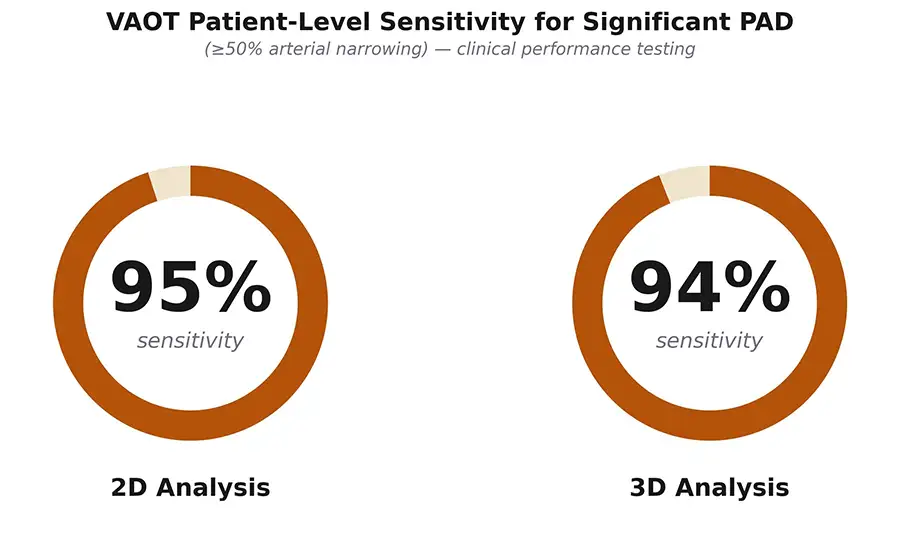
In clinical performance testing, VAOT correctly flagged up to 95% of patients with significant peripheral arterial disease (95% on 2D analysis, 94% on 3D), where “significant” means at least one artery narrowed by 50% or more.2 The software runs inside the imaging systems hospitals already use, so radiologists do not need to change their tools or workflow to adopt it. It supports the radiologist’s read — it does not replace it.
The company is also already public. GuideAI trades as CBOE:GDAI, following the filing of its Final Prospectus on June 12, 2026.3 This is not a story asking investors to take a private company on faith — it is one they can buy shares in today.
There Is Already a Proof of Concept. It Is Worth $176 Million a Year.
At TheMarketsToday, we have spent considerable time covering the AI diagnostics space — a sector full of bold claims, compelling technology, and, far too often, an absence of real-world validation. That is what makes HeartFlow Inc unusual. It is the rare company that has not only made the case for AI-powered vascular imaging in theory, but has built an actual, reimbursed, scaled clinical business on the back of it.
Founded in 2010 by a Stanford bioengineering professor, and a Stanford vascular surgeon,4 HeartFlow Inc spent years developing and clinically validating a platform that applies artificial intelligence to coronary CT angiography scans — turning existing imaging data into a detailed 3D model of the heart that reveals blood flow dynamics previously only measurable through invasive catheterisation. By 2014 it had FDA clearance.5 By 2017, the UK’s NICE recommended its adoption.6 Today, as a publicly listed company on the Nasdaq (ticker: HTFL),7 HeartFlow generated $176 million in revenue in FY2025 — a 40% year-on-year increase — and is guiding to $246–$250 million for FY2026.8 It has treated over 600,000 patients across more than 1,800 institutions worldwide.9
We reference HeartFlow Inc not to write its story — that story is already well told — but because it provides something extremely rare in the medtech AI space: a real life example of the model working. AI applied to vascular imaging, sold into hospitals, generating reimbursable clinical value at scale. The question we have been asking ourselves at TheMarketsToday is simple: where is the company applying the same playbook to the next large, underserved vascular disease population?
We believe the answer is GuideAI Health — and the disease it is targeting may carry an even larger unmet clinical need than the one HeartFlow addressed.
HeartFlow Solved Coronary Disease. We Don’t Know Anyone that has Solved the Periphery Yet.
HeartFlow’s focus is the coronary arteries — the vessels that supply blood to the heart muscle itself. Coronary artery disease is the world’s leading cause of death,10 and HeartFlow’s technology addresses the challenge of determining, non-invasively, whether a blockage is actually restricting blood flow in a clinically meaningful way. It is a powerful, specific, and now well-validated use case.11
But there is a parallel vascular crisis unfolding in a completely different part of the body — one that receives a fraction of the clinical attention, almost none of the dedicated AI investment, and affects an estimated 230 million people worldwide.12 It is called Peripheral Arterial Disease, or PAD — and it is, in the most literal sense, the disease hiding in plain sight.
Peripheral arterial disease describes the narrowing and hardening of arteries outside the heart and brain — most commonly in the legs and lower extremities. Like coronary disease, it progresses silently. Like coronary disease, it is driven by diabetes, hypertension, obesity, smoking, and aging.13 And like coronary disease before HeartFlow, it is routinely caught too late — at the point where intervention has shifted from preventive to reactive, where limbs are already at risk, where the chance to change the trajectory of the disease has already passed.14
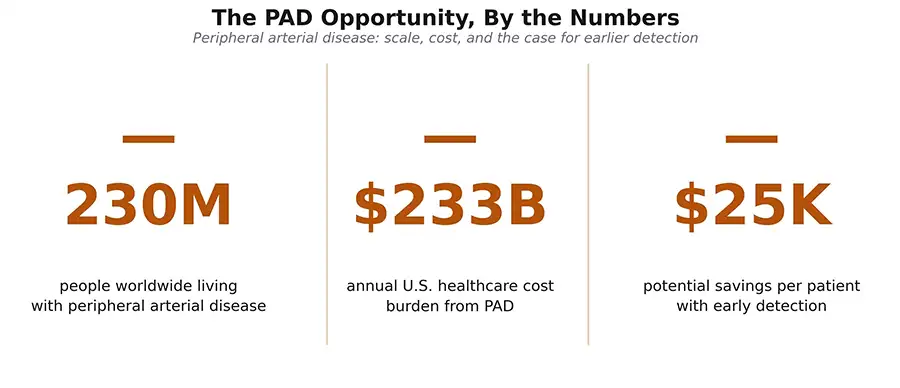
The consequences are severe. Undetected and untreated PAD leads to critical limb ischemia, chronic wounds, non-healing ulcers, and amputation.15 It dramatically elevates the risk of heart attack and stroke.16 It is also expensive at a system level: PAD carries an estimated $233 billion annual healthcare cost burden in the United States alone, with roughly 75% of that spend concentrated in late-stage hospitalizations — the very events earlier detection is designed to avoid.17 Independent analysis reviewed by GuideAI Health CBOE:GDAI indicates that early PAD identification can reduce long-term healthcare costs by up to $25,000 per patient.18 Multiply that across a 230-million-person patient population, and the economic case for getting this right becomes staggering.
GuideAI Health: Built by the Clinicians Who Saw What Was Being Missed
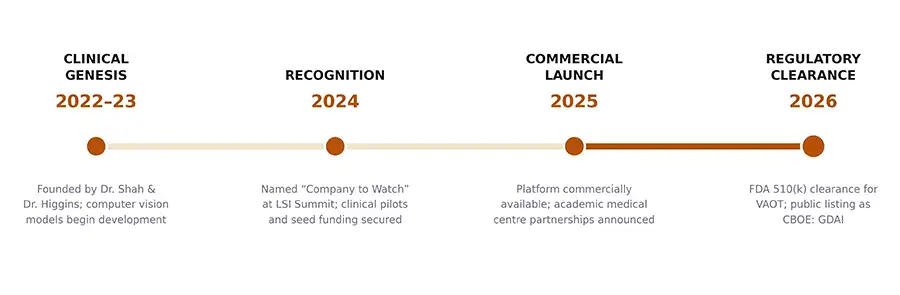
What gives us confidence in GuideAI Health’s approach begins, as it does with HeartFlow, with how the company was founded. GuideAI Health CBOE:GDAI was not created by technologists looking for healthcare applications for AI. It was created by interventional radiologists — clinicians who spent years in the room, reviewing imaging, and repeatedly seeing early signs of PAD that were present in scans but going unidentified in the context of busy, high-volume clinical practice.
Co-founders Dr. Raj Shah and Dr. Luke Higgins identified a recurring pattern: the markers of early PAD were distributed subtly across complex vascular anatomy, variable in presentation, and consistently overlooked — not because radiologists lack skill, but because the human visual system, under time pressure, was not optimised to find signals that AI, trained on thousands of cases, could learn to detect reliably. They brought in Dr. Amin Katouzian to build the AI infrastructure and navigate the regulatory pathway.
Since founding, the leadership bench has deepened considerably. Paul More has joined as Chief Financial Officer and Tasheel Jeerh as President, alongside a board of clinical and strategic advisors that includes Dr. James Benenati (interventional radiology; Chief Medical Officer, Penumbra), and Gail Marcus (Natera, Cigna) — a leadership bench whose clinical depth and operating experience is, in our view, one of the most important differentiators GuideAI Health has.
VascularAssist™: Finding What Others Miss, Before It Becomes Irreversible
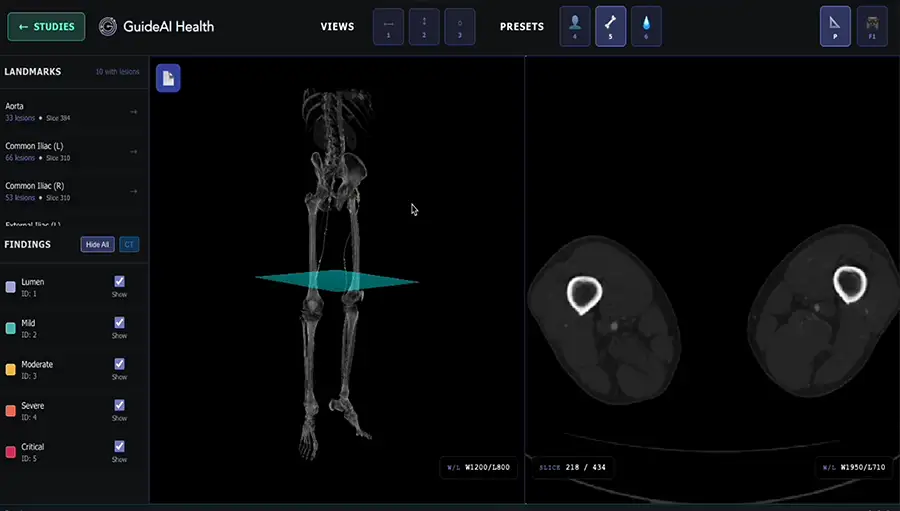
The core of GuideAI Health CBOE:GDAI platform is VascularAssist™ — an AI-powered image activation system designed specifically to detect and characterise early PAD in standard clinical imaging. Like HeartFlow’s platform, it requires no new imaging hardware, no additional scan protocols, and no disruption to established workflows. It works with the data already being collected — and delivers structured, actionable outputs that radiologists and referring clinicians can use immediately.
The AI models underlying VascularAssist™ are trained through GuideAI’s partnership with vRad — exclusive access to more than 1 billion medical images from 2,100+ hospitals, one of the largest training datasets in peripheral vascular AI.19 The system is designed to mimic the diagnostic approach of expert radiologists — not replace it — acting as a force multiplier that allows clinicians to maintain diagnostic quality even as imaging volumes continue to grow and workforce pressures intensify.
The first product built on this platform, VascularAssist Occlusion Triage (VAOT), received FDA 510(k) clearance in June 2026 and is now commercially available in the United States — turning a research platform into a marketed clinical product.
Two Platforms. Same Thesis. Different Battlegrounds.
When we map GuideAI Health CBOE:GDAI directly against HeartFlow, what emerges is a picture of striking philosophical alignment combined with completely distinct clinical territory. These companies are not necessarily competitors. They are parallel expressions of the same idea — applied to different anatomical regions, different patient populations, and very different stages of corporate and market development.
| Category | GuideAI Health | HeartFlow |
|---|---|---|
| Focus | Peripheral arterial disease — arteries of the limbs and extremities outside the heart | Coronary artery disease — the heart's blood supply and flow dynamics |
| Core Product | VascularAssist™ / VAOT — AI image analysis on existing CT scans; structured PAD-detection reports | HeartFlow One — 3D coronary model from CCTA; FFR-CT, plaque characterization |
| Company Stage | FDA-cleared (VAOT, June 2026); publicly listed (CBOE: GDAI); 200+ hospital LOIs; pre-revenue | Public (Nasdaq: HTFL); $176M revenue FY2025; 1,800+ institutions globally |
| Reimbursement | First FDA clearance obtained; reimbursement strategy in development | Category I CPT code secured for FFR-CT; ~99.5% of US lives covered |
| Clinical Evidence | 95% patient-level sensitivity (VAOT); active hospital pilots; academic validation partnerships | 600+ peer-reviewed publications; multiple completed RCTs |
| Disease Population | ~230M people globally with PAD; majority undiagnosed until late-stage | ~200M people globally with coronary artery disease |
| Employees20 | Not publicly disclosed; third-party estimate ~6 (likely undercounted) | 843 (as of Jul 27, 2026) |
| Market Cap | ~US$38M (~CA$53M) as of Jul 29, 2026d) | ~$2.19B (as of Jul 27, 2026) |
| Revenue | $0 — pre-revenue | $176M FY2025; $191.4M trailing twelve months |
| Years Operating | 2–4 yrs (2022–23 per company's own founding story; 2024 per corporate registry) | 16 years (founded 2010) |
The table above illustrates both the gap in maturity and the size of the opportunity. HeartFlow’s achievements in reimbursement, clinical evidence, and commercial scale reflect a 15-year journey. GuideAI Health is very early in that journey — but with one critical advantage HeartFlow did not have when it started: the roadmap already exists, and GuideAI has now converted its first milestone on that roadmap into an actual FDA clearance.
Other AI Imaging Companies We Know of are Focussed on a Different Anatomy
Coronary AI has multiple entrants. Stroke AI has multiple entrants. Acute radiology triage has multiple entrants. Peripheral arterial disease — a 230-million-patient population — currently has – as far as we know – one dedicated public company AI platform.
| Company | Focus Area | PAD Coverage |
|---|---|---|
| Viz.ai | Stroke / Brain | None |
| Aidoc | Acute radiology triage | None |
| Cleerly | Coronary arteries | None |
| HeartFlow | Coronary arteries | None |
| GuideAI Health | Peripheral Vascular | First Mover |
Rather than competing in an established category, GuideAI is helping create one.21
What the Numbers Tell Us About Where AI Vascular Diagnostics Can Go
We think it is worth dwelling for a moment on what HeartFlow’s financial trajectory actually represents — because it is one of the most instructive data points available to anyone evaluating GuideAI Health CBOE:GDAI.
HeartFlow’s growth from early commercial stage to $176 million in annual revenue did not happen overnight. It required among many other steps, FDA clearance, Category I reimbursement codes, the completion of multiple randomised controlled trials, and the gradual accumulation of 600+ peer-reviewed publications. It required building trust with cardiologists, hospital procurement departments, and insurance payers, one account at a time. What it ultimately proved — and this is the critical point — is that AI-powered vascular imaging is not a theoretical clinical benefit. It is a product that hospitals will pay for, that insurers will reimburse, and that generates measurable improvements in patient outcomes.
$936 million in total funding raised.22 A gross margin approaching 80%. A 40% year-on-year revenue growth rate. 340 new institutional accounts added in a single year — described by the company as the strongest new account growth in its history.23 There are obviously substantial differences in the stage of development and maturity of these two companies, and GuideAI would have to achieve a number of significant milestones to follow the same path as HeartFlow — but HeartFlow targeted a disease population of roughly 200 million people, and GuideAI Health is targeting one of 230 million, in a market where the competitive landscape for dedicated peripheral vascular AI is essentially empty.
HeartFlow's climb to $176 million in revenue is reflected today in a market capitalization of roughly $4.25 billion (as of August 26, 2026). GuideAI, still pre-revenue, and with many milestones yet to achieve, but now FDA-cleared and publicly listed, carries a market capitalization of roughly $38 million $38 million (as of July 29, 2026) — pricing in only a small fraction of the trajectory HeartFlow has already proven achievable. That valuation gap — not just the strategic similarity — is where we think the opportunity sits.
200+ Hospital LOIs, a Named Health System Partner, and a Business Model That Compounds
GuideAI has assembled more than 200 global hospital letters of intent ahead of its first signed contract. Advocate Health — a 69-hospital system serving 6 million patients annually — has signed a letter of intent and is now conducting a feasibility assessment for clinical integration. Pilots are underway at Boone Heart Institute and Loma Linda University, alongside validation studies at academic medical centers.24

The Structural Forces That Make This the Right Moment
Beyond the clinical and competitive logic, we see several structural tailwinds that make the current moment particularly favourable for a company like GuideAI Health CBOE:GDAI.
The diabetes epidemic is expanding the patient pool relentlessly. Diabetes is one of the most powerful risk factors for PAD, damaging blood vessels through chronic inflammation and accelerating the atherosclerotic process. The International Diabetes Federation projects global diabetes prevalence to reach 853 million adults by 2050.25 Every new diagnosis represents a patient whose vascular health should be monitored — and who, without early detection tools, is likely to arrive at a clinician’s door only when the disease has already progressed.
The AI in medical imaging market is growing at a rate that surprises even optimistic forecasters. Valued at approximately $2.2 billion globally in 2026, this market is forecast to reach $17.8 billion by 2033 — a compound annual growth rate of 34.8%.26 Healthcare systems that were cautious about AI adoption five years ago are now actively seeking platforms that improve diagnostic accuracy, reduce reporting variability, and help manage the growing radiologist workforce shortage.27
The value-based care transition is creating powerful financial incentives for prevention. As hospitals and health systems are increasingly reimbursed based on outcomes rather than procedure volumes, a platform that prevents amputations, reduces cardiovascular events, and eliminates unnecessary downstream testing is not just a clinical good — it is a financial imperative.
The reimbursement pathway has been charted. HeartFlow’s journey to Category I CPT reimbursement — one of the hardest milestones in US medtech commercialisation — proved that AI vascular imaging tools can navigate this process successfully. The FDA has now approved over 500 AI-enabled medical devices, the majority imaging-focused28 including GuideAI’s VAOT to market.
VascularAssist Gets GuideAI Into the Room. Elevate Becomes the Infrastructure.
The HeartFlow comparison is the right frame for understanding what GuideAI Health CBOE:GDAI is doing today. But the more instructive lesson from HeartFlow’s trajectory is not the imaging algorithm itself — it is what came after it.
HeartFlow did not build a $176 million business by selling a better scan analysis. It built that business by becoming workflow infrastructure — embedded in how cardiologists make decisions, how hospitals bill for diagnostic workups, and how longitudinal cardiovascular care is structured. The imaging model was the entry point. The platform was the moat.
GuideAI Health is building toward the same architecture. VascularAssist™ is the first product and the clinical entry point — now FDA-cleared and ready to generate the institutional relationships and longitudinal patient data that become increasingly valuable over time. Elevate is the platform that is designed to sit above it: a clinical intelligence layer designed to evolve from single-study imaging analysis into longitudinal disease tracking, physician-centred decision support, referral coordination, and structured care pathways for chronic vascular disease management.
GuideAI has now put dates on that ambition. The company is targeting a launch of the Elevate platform at RSNA 2026, and has a second product, CarotidAssist™, on track for application to obtain FDA 510(k) clearance as early as Q1 2027 — a second disease area, and a second revenue layer, on the same infrastructure. An international pilot in India, also targeted for Q1 2027, would mark the company’s first step outside the U.S. market. By the company’s own account, four catalysts move this story next: the VAOT clearance already obtained, the first signed hospital contract, CarotidAssist clearance, and the India pilot.29
The right frame for GuideAI Health today is still the one we have outlined in this report: VascularAssist™ is the HeartFlow of PAD. That comparison is clean, credible, and — as of June 2026 — backed by an actual FDA clearance rather than just a roadmap. What Elevate represents is the potential next chapter: the platform that transforms a strong imaging AI product into a defensible, compounding healthcare business.
The Blueprint Exists. The Clearance Is In Hand. The Stock Now Trades.
We have covered a lot of healthcare AI companies at TheMarketsToday. Many have compelling technology. Fewer have compelling technology applied to a clearly defined clinical need, backed by an actual regulatory clearance. Fewer still have a directly comparable proof point in an adjacent market that confirms the model can work at scale.
GuideAI Health CBOE:GDAI has all three, plus something few pre-revenue medtech companies can claim this early: a green light from the FDA. The clinical need — PAD affecting 230 million people, routinely diagnosed too late — is as clearly documented as any we have seen. The technology VascularAssist™ and its first cleared product, VAOT, validated with 95% patient-level sensitivity is designed specifically for this problem.
The commercial foundation, an exclusive dataset of 1 billion+ images via vRad, and a named health system partner in Advocate Health — is a real pipeline, not a slide. And the proof of concept — HeartFlow’s $176 million business, now valued at roughly $3.02 billion, built on the same fundamental thesis in the coronary space — is as direct a validation of the commercial model as we could ask for.
What GuideAI Health is building is not a replication of HeartFlow. The anatomy is different, the clinical workflows are different, the patient population is different. But the core proposition — that AI can find the signal in existing imaging data that human review misses, earlier in the disease process, in ways that fundamentally change outcomes and reduce systemic healthcare costs — is identical. And that proposition, HeartFlow has now proven beyond reasonable doubt, is one the market will pay for.
For hospital systems evaluating their next generation of AI diagnostic tools, for clinical partners looking to reduce the burden of late-stage vascular disease, and for investors who followed the HeartFlow story and wished they had gotten in earlier — GuideAI Health, now trading as CBOE: GDAI, deserves a very close look.
IMPORTANT DISCLAIMER
This is a paid promotion prepared on behalf of GuideAI Health Corp. The Markets Today and its affiliates have been compensated for the creation and distribution of this content and may hold a position in the securities discussed. This content is for informational and promotional purposes only and does not constitute investment advice, a recommendation, or a solicitation to buy or sell any security. Forward-looking statements, including revenue projections and roadmap timelines, are subject to risks and uncertainties and may not be achieved. Past performance, including that of HeartFlow, Inc., is not indicative of future results for GuideAI Health Corp. Market and company data are sourced from public filings and third-party research and are subject to revision. Always consult a licensed financial advisor and conduct independent due diligence, including a review of GuideAI Health Corp.’s Final Prospectus filed on SEDAR+, before making any investment decision.
This content contains forward-looking statements and forward-looking information within the meaning of applicable Canadian securities laws. Forward-looking statements are statements that are not purely historical and include statements regarding expectations, beliefs, estimates, plans, intentions, opportunities, projections, targets, objectives, assumptions, future events or future performance. Forward-looking statements are often, but not always, identified by words and phrases such as “may”, “will”, “would”, “could”, “should”, “expect”, “intend”, “plan”, “anticipate”, “believe”, “estimate”, “forecast”, “target”, “project”, “potential”, “designed to”, “aimed at”, “seeking”, “on track”, “roadmap”, “opportunity”, “pipeline”, “catalyst”, “next chapter”, “path”, “trajectory”, “thesis”, “can”, “becomes”, “will pay for”, “deserves”, “we believe” and similar expressions.
Without limiting the generality of the foregoing, the forward-looking statements in this content include statements and implications concerning: (i) GuideAI Health’s potential transformative impact in healthcare AI, its ability to prove or capture an underserved market, and the timing or significance of FDA clearance and public listing milestones; (ii) the potential ability of VascularAssist Occlusion Triage, VascularAssist or related technology to flag signs of blocked or narrowed arteries, prioritize urgent cases, support radiologists, fit within existing hospital imaging systems and workflows, improve diagnostic quality, function as a force multiplier, or identify what may otherwise be missed; (iii) the possible clinical utility, scalability, commercial value or market acceptance of AI-enabled peripheral vascular imaging tools; (iv) the size, characteristics and commercial significance of the PAD population, including statements regarding unmet clinical need, underdiagnosis, disease progression, healthcare cost burden, potential cost savings from early identification, and the possibility that early detection could reduce amputations, cardiovascular events, downstream testing, hospitalizations or other healthcare costs; (v) the assertion or implication that the HeartFlow business model, commercial path, reimbursement journey, market response, valuation or revenue trajectory provides a roadmap, proof of concept or validation for GuideAI Health; (vi) statements comparing GuideAI Health to HeartFlow or other companies, including statements that GuideAI Health may be applying a similar playbook, may have an analogous opportunity in a different clinical territory, may be early in a comparable journey, or may benefit from a valuation gap or strategic similarity; (vii) statements that the competitive landscape for dedicated peripheral vascular AI is limited, empty or favourable, or that GuideAI Health is a first mover, category creator or uniquely positioned public company platform in PAD-focused AI imaging; (viii) statements regarding hospital letters of intent, Advocate Health, feasibility assessments, pilots, validation studies, academic partnerships and the possibility that any such relationships, studies, assessments, pilots or letters of intent may result in definitive agreements, clinical integration, revenue, reimbursement, commercial scale, patient data, institutional relationships or broader market adoption; (ix) statements regarding structural tailwinds, including diabetes prevalence trends, growth in AI medical imaging markets, radiologist workforce pressures, value-based care incentives, healthcare procurement trends, payer behaviour, hospital demand and the potential effect of those trends on GuideAI Health’s business; (x) statements that reimbursement pathways have been charted, that AI vascular imaging tools can navigate reimbursement processes, or that GuideAI Health may obtain reimbursement, coding, payer coverage or commercial acceptance; (xi) statements regarding the Elevate platform, including its expected functions, ability to evolve from single-study imaging analysis into longitudinal disease tracking, clinical intelligence, physician-centred decision support, referral coordination, structured care pathways or workflow infrastructure, and its potential to become a moat, platform, defensible business or compounding healthcare business; (xii) statements regarding anticipated future milestones, catalysts and timelines, including any targeted launch of Elevate at RSNA 2026, any application for or receipt of FDA 510(k) clearance for CarotidAssist as early as Q1 2027, any international pilot in India targeted for Q1 2027, any first signed hospital contract, any second disease area or revenue layer, and any other product, market, partnership, regulatory or commercialization milestone; (xiii) statements regarding GuideAI Health’s business model, product roadmap, revenue potential, market capitalization, valuation opportunity, investor interest, trading opportunity, prospective return profile or reasons investors may wish to evaluate or purchase its securities; and (xiv) any other statements regarding future clinical, regulatory, operational, commercial, financial, market, partnership, technological or investor-related outcomes.
The forward-looking statements in this content are based on assumptions believed to be reasonable as of the date of publication, including assumptions regarding the accuracy and completeness of public filings, company materials and third-party information; the continued availability and usefulness of datasets, hospital relationships, clinical advisors, management, collaborators, vendors and research partners; the clinical performance, safety, reliability, interoperability and scalability of GuideAI Health’s technology; hospital, radiologist, physician, patient, payer and regulator acceptance of AI-enabled imaging solutions; the ability to obtain, maintain, expand and commercialize regulatory clearances; the ability to convert letters of intent, pilot programs, feasibility assessments and validation studies into definitive commercial relationships; the availability of reimbursement, coding, payer coverage and procurement support; the continued growth of relevant healthcare and AI-imaging markets; the continued relevance of PAD as a clinical and economic burden; the availability of capital on acceptable terms; the absence of material adverse changes in law, regulation, competition, technology, public markets, healthcare policy, reimbursement policy, cybersecurity, privacy or data access; and the continued execution of GuideAI Health’s business plan. These assumptions may prove incorrect.
Forward-looking statements are subject to known and unknown risks, uncertainties and other factors that could cause actual results, performance, achievements or developments to differ materially from those expressed or implied by such statements. These risks include, without limitation: risks related to GuideAI Health’s early stage of development, limited operating history and pre-revenue status; the risk that FDA 510(k) clearance for VAOT does not result in revenue, reimbursement, hospital adoption, clinical use, commercial scale, investor returns or clearance of future products; the risk that clinical performance data, validation studies or pilot results may not be replicated, expanded, accepted by clinicians or payers, or sufficient for commercial adoption; the risk that letters of intent, feasibility assessments, pilots, academic collaborations, hospital relationships or strategic partnerships may be non-binding, delayed, terminated, narrowed or never converted into definitive contracts or revenue; the risk that Advocate Health, Boone Heart Institute, Loma Linda University or other named or unnamed counterparties may not proceed beyond exploratory, pilot, feasibility, validation or limited-scope arrangements; regulatory risks, including delays, denials, limitations, withdrawals or failures in obtaining, maintaining or expanding FDA, Health Canada or other regulatory clearances; risks relating to claims about clinical utility, workflow integration, prioritization of urgent cases, diagnostic support, early detection, cost savings and prevention of downstream adverse outcomes; reimbursement, coding, payer acceptance, procurement and billing risks; risks related to product performance, false positives, false negatives, bias, limitation of training data, interoperability, cybersecurity, privacy, medical data access and healthcare information systems; medical device liability, patient safety, professional liability and product liability risks; dependence on key personnel, clinical advisors, technology providers, data providers, hospitals, vendors and collaborators; risks relating to intellectual property, trade secrets, licensing, data rights and exclusivity; competition from existing and future medical imaging, radiology, vascular, cardiovascular, hospital workflow and healthcare AI companies, including better-capitalized or more established competitors; risks that market size, disease prevalence, healthcare cost, cost-saving and market-growth estimates are overstated, outdated, not independently verified or not applicable to GuideAI Health’s products; risks inherent in comparing GuideAI Health to HeartFlow or any other more mature company; risks related to public market volatility, valuation, trading liquidity, analyst or investor interest, financing needs, dilution and capital availability; risks related to operating in Canada, the United States, India or other jurisdictions; risks related to economic conditions, healthcare budgets, hospital procurement cycles, inflation, interest rates and general capital market conditions; and the other risks described in GuideAI Health’s public disclosure record, including its Final Prospectus filed on SEDAR+.
Forward-looking statements should not be read as guarantees of future performance. Actual outcomes could differ materially, and no representation or assurance is made that GuideAI Health will achieve any regulatory clearance, clinical result, product launch, hospital contract, revenue, reimbursement status, payer coverage, market share, valuation, market capitalization, commercial scale, patient outcome, healthcare cost saving, international expansion, investor return or other milestone described or implied in this content. Past performance of GuideAI Health, HeartFlow or any other company is not indicative of future results. The fact that another company has achieved FDA clearance, reimbursement, revenue, market capitalization, institutional adoption or clinical validation does not mean GuideAI Health will achieve comparable results. Readers should not place undue reliance on forward-looking statements.
Market, clinical, medical, financial and third-party data referenced in this content are derived from public filings, company materials, third-party research, websites and other sources believed to be relevant, but they may be incomplete, unaudited, outdated, subject to revision, based on assumptions, not independently verified, or not prepared in accordance with standards applicable to securities disclosure. This content does not constitute medical advice, investment advice, an offer to sell or a solicitation of an offer to buy any security. Readers should conduct their own independent due diligence, including reviewing GuideAI Health’s public disclosure on SEDAR+, and should consult their own legal, financial, tax, medical and other professional advisors before making any investment or other decision. Except as required by applicable law, no obligation is undertaken to update or revise any forward-looking statement after the date of publication, whether as a result of new information, future events or otherwise.
GENERAL NOTICE AND DISCLAIMER
PLEASE READ CAREFULLY
We are engaged in the business of advertising and promoting companies. All content on our website is for informational purposes only and should not be construed as an offer or solicitation of an offer to buy or sell securities. Neither the information presented nor any statement or expression of opinion, or any other matter herein, directly or indirectly constitutes a solicitation of the purchase or sale of any securities. Neither the owner of www.diemarkteheute.com nor any of its members, officers, directors, contractors or employees are licensed broker-dealers, account representatives, market makers, investment bankers, investment advisors, analyst or underwriters. Investing in securities, including the securities of those companies profiled or discussed on this website is for individuals tolerant of high risks. Viewers should always consult with a licensed securities professional before purchasing or selling any securities of companies profiled or discussed on diemarkteheute.com. It is possible that a viewer’s entire investment may be lost or impaired due to the speculative nature of the companies profiled. Remember, never invest in any security of a company profiled or discussed on this website unless you can afford to lose your entire investment. Also, investing in micro-cap securities is highly speculative and carries an extremely high degree of risk. diemarkteheute.com makes no recommendation that the securities of the companies profiled or discussed on this website should be purchased, sold or held by viewers that learn of the profiled companies through our website. diemarkteheute.com has been retained by an unrelated third party to perform promotional and advertising services for a limited time with respect to the company we are profiling or discussing on this website and in exchange for such services has received cash compensation from such third party.
The development and commercialization of artificial intelligence and health-technology products are highly speculative and are characterized by a number of significant inherent risks, which may result in the inability to successfully develop or commercialize products for commercial, technical, regulatory or financial reasons, or if successfully developed, may not remain economically viable owing to any of the foregoing reasons. There is no assurance that GuideAi Health Corp. will be successful in achieving a return on shareholders’ investment and the likelihood of success must be considered in light of the early stage of operations.
GuideAi Health Corp.’s ability to develop, validate and commercialize its artificial intelligence and health technology platforms in sufficient quality and scale to justify continued development activities and/or its ability to commence and complete product development and/or commence and/or sustain commercial operations will depend upon numerous factors, many of which are beyond its control, including product development success, the obtaining of funding for all phases of research, development and commercialization, the adequacy of technology infrastructure, the performance and reliability of underlying artificial intelligence models and data sets, the availability of computing and data-processing capacity, the availability of and demand for artificial intelligence-enabled health solutions, the availability of qualified engineering, data science, clinical and regulatory personnel, the cost of technology, data and cloud infrastructure, technological and cybersecurity risks including data breaches or system failures, changes in privacy, health and artificial intelligence regulations, the receipt of necessary regulatory approvals, clearances, consents, permits and licenses (including health regulatory approvals where applicable), competition from other technology and health-technology providers, and political and regulatory factors, including unexpected changes in governments or governmental policies towards artificial intelligence, data privacy and health technology.
Furthermore, cost over-runs or unexpected changes in technology, market conditions or the regulatory environment in any future development could make GuideAi Health Corp.’s products or business plan uneconomic, even if previously determined to be viable under internal projections or third-party studies. Accordingly, notwithstanding positive results of any studies, trials or projections, there is a risk that GuideAi Health Corp. would be unable to complete development and commence or sustain commercial operations, which would have a material adverse effect on its business, financial condition, results of operations and prospects.
For a more comprehensive overview of the risks related to GuideAi Health Corp.’s business, please review GuideAi Health Corp.’s continuous disclosure documents, each filed under the Company’s profile at www.sedarplus.ca.
PAID ADVERTISEMENT. This communication is a paid advertisement and is not a recommendation to buy or sell securities. Upswitch Media Corp. and its owners, managers, employees, and assigns (collectively “Upswitch Media Corp”) has been paid for GuideAi Health Corp. (the “Company”) Five Hundred Thousand Canadian dollars (CAD$500,000) plus applicable taxes for an ongoing marketing campaign and is including this article, among other things. This compensation is a major conflict with our ability to be unbiased. This communication is for entertainment purposes only. Never invest purely based on our communication.
SHARE OWNERSHIP. The owner of Upswitch Media Corp. may be buying and selling shares of this issuer for its own profit. This is why we stress that you conduct extensive due diligence as well as seek the advice of your financial advisor or a registered broker-dealer before investing in any securities. This relationship and the compensation to be received by us is a major conflict with our ability to be unbiased.
Questions regarding this website may be sent to info@themarketstoday.com. Some of the content on this website contains forward-looking information within the meaning of Section 27A of the Securities Act of 1993 and Section 21E of the Securities Exchange Act of 1934 including statements regarding expected continual growth of a company and the value of its securities. In accordance with the safe harbor provisions of the Private Securities Litigation Reform Act of 1995 it is hereby noted that statements contained herein that look forward in time which include everything other than historical information, involve risk and uncertainties that may affect a company’s actual results of operation. A company’s actual performance could greatly differ from those described in any forward-looking statements or announcements mentioned on this website or the websites contained within. Factors that should be considered that could cause actual results to differ include: the size and growth of the market for the company’s products; the company’s ability to fund its capital requirements in the near term and in the long term; pricing pressures; unforeseen and/or unexpected circumstances or happenings; technological change and competition; the company’s ability to attract and retain qualified personnel; the reliability and performance of artificial intelligence models and underlying data; changes in privacy, data-protection, health and artificial intelligence regulation; etc. and the risk factors and other factors set forth in the company’s filings with the Securities and Exchange Commission. However, a company’s past performance does not guarantee future results. Generally, the information regarding a company profiled or discussed on this website is provided from public sources. diemarkteheute.com makes no representations, warranties or guarantees as to the accuracy or completeness of the information provided or discussed. Viewers should not rely solely on the information obtained through our website or in communications originating from our website. Viewers should use the information provided by us regarding the profiled companies as a starting point for additional independent research on the companies profiled or discussed in order to allow the viewer to form his or her own opinion regarding investing in the securities of such companies. Factual statements, or the similar, made by the profiled companies are made as of the date stated and are subject to change without notice and diemarkteheute.com has no obligation to update any of the information provided. diemarkteheute.com, its owners, officers, directors, contractors and employees are not responsible for errors and omissions. From time to time certain content on this website is written and published by our employees or third parties. In addition to information about our profiled companies, from time to time, our website will contain the symbols of companies and/or news feeds about companies that are not being profiled by us but are merely illustrative of certain activity in the technology or health-technology sector that we are highlighting. Viewers are advised that all analysis reports and news feeds are issued solely for informational purposes. Any opinions expressed are subject to change without notice. It is also possible that one or more of the companies discussed or profiled on this website may not have approved certain or any statements within the website. diemarkteheute.com encourages viewers to supplement the information obtained from this website with independent research and other professional advice. The content on this website is based on sources which we believe to be reliable but is not guaranteed by us as being accurate and does not purport to be a complete statement or summary of the available data.
Third Party Web Sites and Other Information. This website may provide hyperlinks to third party websites or access to third party content. diemarkteheute.com, its owners, officers, directors, contractors and employees are not responsible for errors and omissions nor does diemarkteheute.com control, endorse, or guarantee any content found in such sites. By accessing, viewing, or using the website or communications originating from the website, you agree that diemarkteheute.com, its owners, officers, directors, contractors and employees, are not responsible for any content, associated links, resources, or services associated with a third party website. You further agree that diemarkteheute.com, its owners, officers, directors, contractors and employees shall not be liable for any loss or damage of any sort associated with your use of third party content. Links and access to these sites are provided for your convenience only. diemarkteheute.com uses third parties to disseminate information to subscribers.
diemarkteheute.com also places cookies on your computer to allow third party ads to retarget your IP address. Although we take precautions to prevent others from obtaining our subscriber list, there is a risk that our subscriber list, through no wrong doing on our part, could end up in the hands of an unauthorized party and that subscribers will receive communications from unauthorized third parties. We encourage viewers to invest carefully and read the investor issuer information available at the web sites of the United States Securities and Exchange Commission (SEC). The SEC has launched an investor-focused website to help you invest wisely and avoid fraud at www.investor.gov and filings made by public companies can be viewed at www.sec.gov and/or the Financial Industry Regulatory Authority (FINRA) at: www.finra.org. In addition, FINRA has published information at its website on how to invest carefully at www.finra.org/Investors/index.htm.
Income Disclaimer: Testimonials and examples used here are exceptional results which may not apply to the average purchaser. They are not intended to represent or guarantee that anyone will achieve the same or similar results through our service. The use of our information should be based on your own due diligence, and you agree that our company is not liable for any success or failure of your business that is directly or indirectly related to the use of our information. As with any business, your results may vary, and will be based on your individual capacity, business experience and expertise. There are no guarantees concerning the level of success you may experience. Income statements made by our customers are only estimates of what they have earned; there is no guarantee that you will make these levels of income. When using our information, you accept the risk that these earnings and income statements differ by individual. There is no assurance that examples of past earnings can be duplicated in the future. There are unknown risks in business and on the internet that we cannot anticipate which can reduce results. We therefore cannot guarantee your future results or success, and are not responsible for your actions.
Real-time analysis for the modern investor.
All rights reserved.
© 2026 Upswtich Media Ltd.